
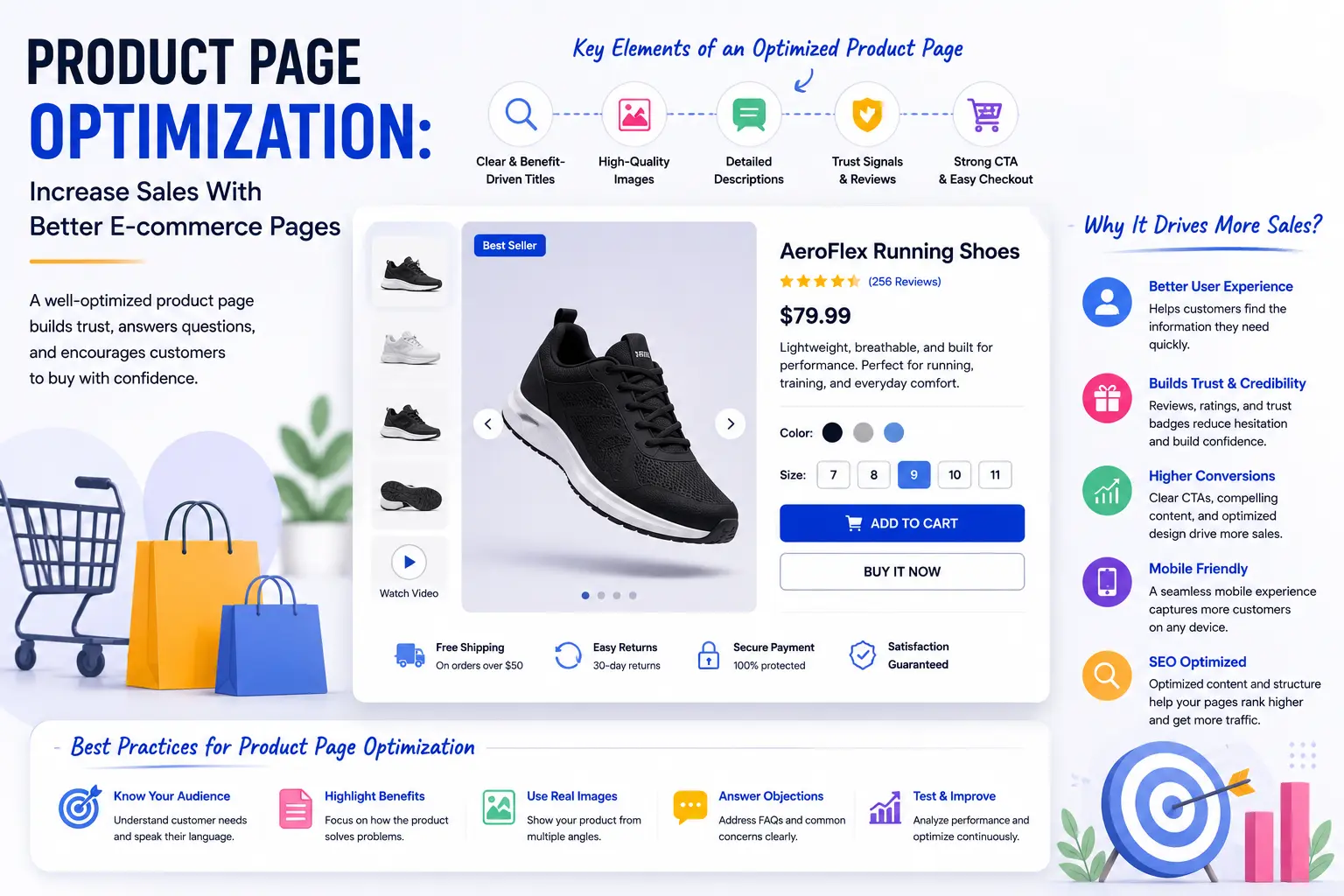
A product page is often the final stop before a purchase decision, yet it’s one of the most overlooked areas of an online store. Product page optimization turns that page from a static listing into a genuine sales tool by improving how products are described, shown, and structured for both shoppers and search engines. This guide covers the practical elements that make product pages convert better and rank higher.
Even strong traffic won’t convert if the product page itself creates doubt or friction. Product page optimization addresses both sides of that problem: it improves visibility in search so the right shoppers arrive, and it improves clarity and trust once they land, so more of them buy. Small improvements here often produce a bigger revenue lift than acquiring additional traffic, since you are converting visitors you already have.
Learning how to optimize product pages for sales starts with identifying the handful of elements that influence a buying decision most: clear pricing, strong product images, a persuasive but honest description, visible trust signals, and a frictionless path to checkout. Every other optimization builds on getting these fundamentals right first.
Product page SEO tips often get overlooked in favor of homepage or category-level optimization, but individual product pages are frequently what shoppers land on directly from search. Use descriptive, keyword-relevant titles rather than generic manufacturer names, write unique meta descriptions for each product, and structure content with clear headings. Implementing schema markup for products, including price, availability, and reviews, also helps listings stand out directly in search results with rich snippets.
Product description optimization means writing copy that answers real buying questions rather than simply listing specifications. Lead with the core benefit, follow with specific features that support it, and address common objections directly in the copy. Avoid copying manufacturer descriptions verbatim, since duplicate content across multiple sellers hurts both rankings and differentiation.
Strong ecommerce copywriting tips center on writing for the customer’s outcome, not just the product’s attributes. Instead of “500ml capacity,” describe what that capacity means for the buyer’s actual use case. Keep sentences short, use bullet points for scannable specs, and write in a tone consistent with your brand across every product page, since inconsistency erodes trust at scale.
Product image optimization for ecommerce covers both visual quality and technical performance. Use multiple angles, lifestyle shots showing the product in use, and zoom functionality so shoppers can inspect details closely. Just as important, compress images properly so they don’t slow page load times, since slow-loading product pages are a common, avoidable cause of abandoned sessions.
Product page UX design determines how easily a shopper can find the information they need to decide. Keep the “buy” button visible without excessive scrolling, place reviews and social proof near the decision point rather than buried at the bottom, and ensure the layout works cleanly on mobile, where most ecommerce browsing now happens. A cluttered or confusing layout adds friction at exactly the moment a shopper is deciding whether to buy.
Beyond design and copy, ecommerce product page best practices include displaying clear shipping and return policies, showing real customer reviews, and using urgency signals like stock levels honestly rather than artificially. These elements work together to reduce the hesitation that causes cart abandonment, and they matter more the higher the price point of the product.
To increase ecommerce conversions consistently, treat product pages as something to test and refine rather than set once and forget. A/B test headlines, image order, and CTA button placement, and track which changes actually move conversion rate rather than relying on assumptions. Pairing this with broader SEO strategy ensures optimized pages also attract the right traffic to convert in the first place.
High converting product pages typically share the same traits: fast load times, clear and honest descriptions, strong visual proof, easy navigation, and a checkout process with minimal friction. None of these require flashy design tricks, just consistent execution across every product in the catalog, which is often where stores fall short at scale.
A practical product page checklist for online stores includes:
Running through this checklist regularly helps catch pages that have quietly fallen behind as a catalog grows.
Optimizing individual pages matters, but the underlying platform determines how easily those optimizations can be applied across an entire catalog. A well-structured eCommerce website makes it far easier to apply consistent SEO, images, and UX improvements at scale, rather than fixing pages one by one. For stores built on WordPress, pairing solid WordPress development with a clear product page structure keeps optimization manageable even as the catalog grows.
What is product page optimization? Product page optimization is the process of improving a product page’s content, images, structure, and technical setup to increase both search visibility and conversion rate.
How do I know if my product pages need optimization? Signs include high traffic with low conversion rates, slow page load times, thin or duplicate descriptions, and product pages that rank poorly for relevant search terms.
Does product image quality really affect sales? Yes, clear, well-lit, multi-angle product images directly influence buyer confidence and are one of the strongest factors in reducing purchase hesitation.
Should every product page have unique content? Yes, unique titles and descriptions avoid duplicate content issues and allow each page to target specific search terms relevant to that product.
How often should product pages be reviewed and updated? Product pages should be reviewed regularly, especially after changes in pricing, stock, or customer feedback, and tested periodically to identify conversion improvements.
Product page optimization is one of the highest-leverage improvements an online store can make, since it directly affects the moment a visitor decides whether to buy. From SEO and imagery to copywriting and UX, every element compounds into a page that builds trust and drives action. If your product pages need a structural refresh rather than piecemeal fixes, Teknoppy’s eCommerce team can help rebuild them with conversion and scalability in mind.

Communicate with our experts to bring out better solutions to your problem.
 +91 6282249224
This will close in 0 seconds


