
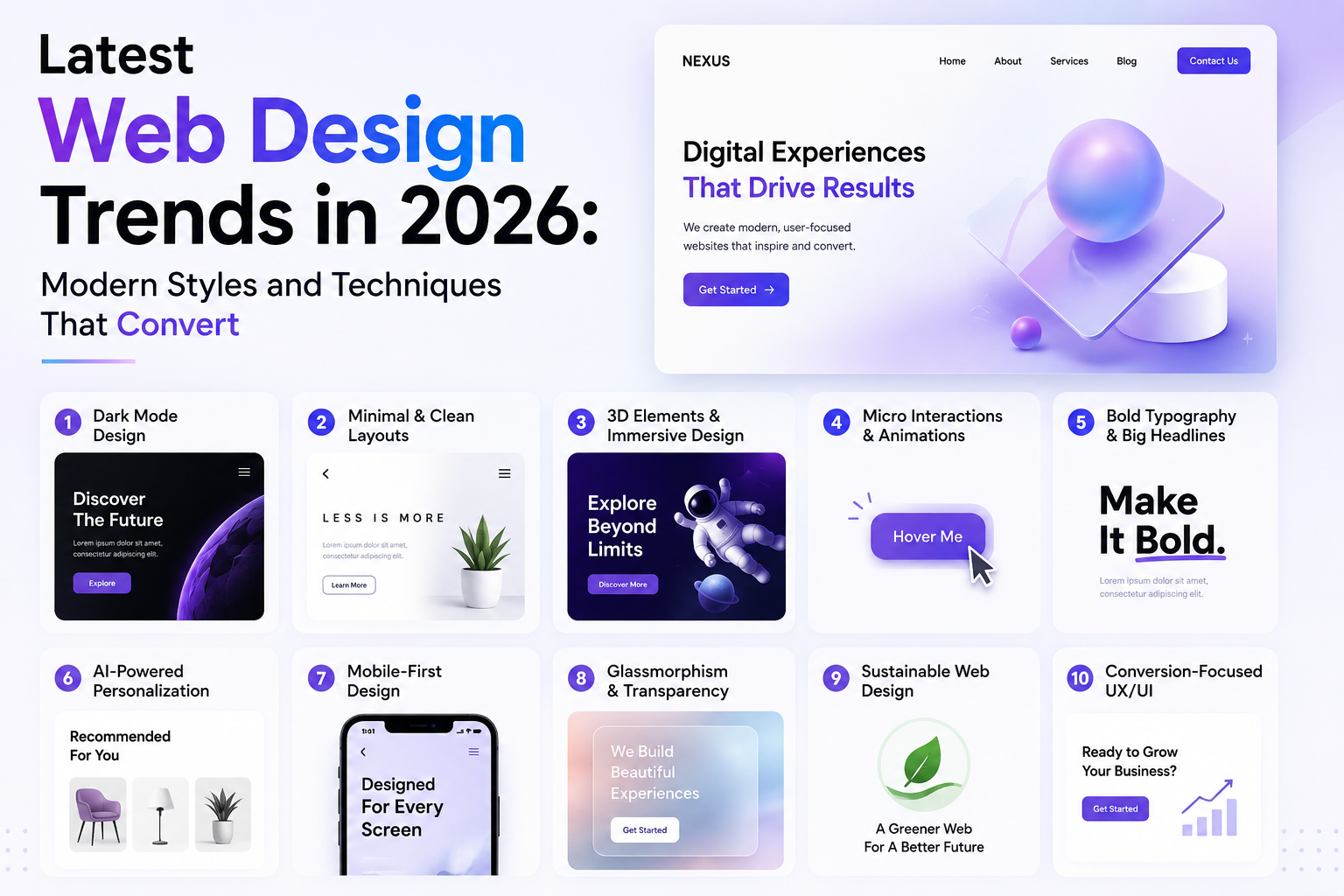
Your website is either working for you or against you. In 2026, there is very little middle ground.
User expectations have shifted dramatically. Visitors now judge your brand within milliseconds of landing on your site — and if your design feels dated, slow, or confusing, they leave before you ever get the chance to make your case.
The good news? Web design trends in 2026 are not just about aesthetics. The most impactful modern website design trends 2026 are deeply tied to performance, user psychology, and conversion rate optimization. This means staying current with design is now a direct business growth strategy — not a vanity exercise.
Whether you are a business owner in Kochi planning a website redesign, a marketing manager evaluating your digital presence, or a designer benchmarking your work against the industry, this guide covers everything shaping the web right now.
Is your current website keeping up with 2026 design standards? Get a free website audit from Teknoppy and find out exactly what is holding your online presence back.
Design is no longer just a layer of polish applied on top of a working website. In 2026, UI UX trends 2026 are directly shaping:
For businesses in competitive markets — whether in Kochi, across Kerala, or targeting national and international audiences — a website that reflects best web design styles 2026 is a significant competitive advantage.
Let us break down every major trend that is defining the industry this year.
AI-powered web design 2026 is the most transformative shift the industry has seen in a decade — and it is still accelerating.
AI is now influencing web design at multiple levels simultaneously:
Design tools integrated with generative AI — including Figma’s AI features, Adobe Firefly, and emerging web-specific tools — allow designers to produce layout variations, generate imagery, and test colour systems at speeds that were impossible two years ago. This compresses timelines and reduces cost for clients without reducing design quality.
The latest frontend design trends 2026 include websites that adapt their content, layout, and calls-to-action dynamically based on visitor behaviour. An e-commerce site might show different homepage content to a first-time visitor versus a returning customer. A service business might surface different testimonials based on the visitor’s industry or location.
This kind of personalisation, once reserved for enterprise platforms with custom development budgets, is now accessible through tools like Webflow Optimize, Unbounce Smart Traffic, and custom-built React applications with AI inference layers.
Static contact forms are being replaced by intelligent conversational interfaces that guide users through discovery, qualification, and enquiry in a natural, chat-based flow. These AI chat modules reduce friction and capture leads at higher rates than traditional form designs.
Explore how Teknoppy’s web design and development services in Kochi incorporate modern AI-ready design frameworks that future-proof your digital presence.
Minimalist web design 2026 has matured beyond simple white space and clean typography. The modern minimalist approach is strategic and intentional — every element on the page earns its place by serving a clear purpose.
What defines high-performing minimalist design in 2026:
The business case for minimalism is now supported by extensive data. Simpler pages load faster, score higher on Core Web Vitals, reduce decision fatigue for visitors, and consistently outperform cluttered designs on A/B conversion tests.
For small and medium businesses in Kochi and across Kerala, the minimalist approach also means lower maintenance complexity and faster page load times on mobile networks — a significant advantage when a large portion of your audience is browsing on smartphones.
Mobile-first design trends 2026 are not a trend in the traditional sense — they are the baseline standard. But in 2026, mobile-first has evolved from a responsive layout requirement into a complete rethinking of content hierarchy, interaction design, and performance targets.
The most important shifts in mobile-first design this year:
With screen sizes growing and users holding phones with one hand, navigation elements, primary CTAs, and interactive components are increasingly designed for the bottom half of the screen — the natural thumb movement zone. Top-of-screen navigation requires a deliberate reach and is being reconsidered in mobile UX design.
The content that matters most appears first, without requiring scrolling. This sounds obvious, but the majority of websites still place their most important conversion elements — contact buttons, key product features, social proof — below the fold on mobile.
Page weight, image formats, font loading, and animation complexity are now design decisions, not just developer concerns. Designers who understand how their choices affect Core Web Vitals — LCP, CLS, and INP — are producing sites that perform measurably better in Google search.
For a technical deep-dive into optimising these metrics, read Teknoppy’s guide on Core Web Vitals optimisation for LCP, CLS, and INP in 2026.
Dark mode web design trends 2026 have moved from a novelty toggle to an expected design feature — particularly in technology, SaaS, creative agency, and professional services categories.
Dark mode is no longer just about aesthetics. It carries real functional benefits:
The most common mistake in dark mode implementation is simply inverting colours. Effective dark mode design requires:
Dark mode is particularly effective for portfolio websites, tech product landing pages, and premium service brands where the visual impact of a dark canvas reinforces sophistication and confidence.
Micro-interactions web design 2026 are the small, purposeful animations and feedback responses that make a website feel alive and intelligent rather than static.
Examples of micro-interactions that are now considered standard in professional web design:
Micro-interactions serve a deeper purpose than decoration. They provide feedback that confirms user actions, reduce uncertainty about what the interface is doing, and create a sense of responsiveness that directly correlates with perceived quality and trust.
The key constraint in 2026 is performance. Every micro-interaction must be implemented in a way that does not degrade Core Web Vitals scores. CSS-based animations that run on the GPU compositor thread are preferred over JavaScript-heavy implementations that can block rendering.
Glassmorphism web design 2026 has settled into a refined, mature phase after its initial surge in popularity. The frosted glass aesthetic — translucent UI panels with blur effects and subtle borders — is now being used with much greater restraint and purpose than in its early, over-applied iterations.
Where glassmorphism works effectively in 2026:
The refinement comes from combining glassmorphism selectively with solid UI elements rather than applying it across an entire interface. Pure glassmorphism-only interfaces can become visually fatiguing and create accessibility challenges — the best implementations in 2026 use it as a strategic accent within a broader design system.
Scroll animation website trends 2026 reflect a fundamental shift in how web content is consumed. The scrolling experience is now treated as a narrative — a journey that reveals content, builds context, and guides the user toward a decision.
The most effective scroll animation patterns in 2026:
Elements animate into view as the user scrolls down — fading in, sliding from the side, or scaling up from a smaller size. When implemented with purpose, these reveals create a sense of discovery and maintain engagement across longer pages.
Background elements move at a slower scroll rate than foreground content, creating depth and a sense of three-dimensional space. Used carefully, this technique makes brand imagery feel more cinematic and immersive.
Some 2026 designs are experimenting with horizontal scroll sections within a vertical page flow — particularly for showcasing portfolios, product ranges, or process steps. These require careful UX consideration to ensure they work equally well on desktop and mobile.
Content animations that are tied directly to scroll position — where the animation plays as you scroll and reverses as you scroll back — create a deeply interactive feel without requiring user input beyond natural scrolling behaviour.
The performance caveat is critical: scroll animations implemented poorly can severely degrade Interaction to Next Paint (INP) scores. The industry standard in 2026 is the Intersection Observer API combined with CSS animations, not scroll event listeners with JavaScript-driven transforms.
Typography trends web design 2026 have elevated type from a content delivery mechanism to a primary visual design element. The best websites this year are using typography to create mood, guide hierarchy, and establish brand personality — not just to display readable text.
Defining typography characteristics in 2026:
For businesses in Kochi and across India, typography choices also need to account for Malayalam and other regional language rendering — an often-overlooked detail that matters enormously for localised websites and regional market targeting.
Accessibility web design standards 2026 have moved from an ethical consideration to a legal and commercial imperative. With digital accessibility legislation strengthening across markets, and Google’s increasing weighting of accessibility signals in search quality assessments, building accessible websites is now a core competency for every professional web design team.
What accessibility-first design looks like in practice:
Crucially, accessible design and beautiful design are not in conflict. The discipline that accessibility demands — clear hierarchy, strong contrast, predictable interaction patterns — produces design that performs better for all users, not just those with specific access needs.
Conversion-focused web design 2026 is where aesthetics and business strategy converge. The most forward-thinking website design techniques that convert 2026 are built around clearly defined user journeys, psychological triggers, and measurable outcomes — not just visual appeal.
Key conversion design principles dominating 2026:
The hero section must communicate who you are, what you offer, and why the visitor should care — in under five seconds. This requires ruthless editing of copy, a single dominant CTA, and visual hierarchy that directs the eye from headline to supporting statement to action.
Testimonials, client logos, case study results, and review scores are now integrated directly into the conversion flow — not relegated to a separate “testimonials page” that most users never visit. In 2026, social proof appears at every point where doubt might emerge in the user’s mind.
Every major CTA should be supported by a nearby trust signal — a security badge, a money-back guarantee, a client count, or a recognised accreditation. This micro-reassurance reduces the psychological friction of taking action.
The best conversion-focused web design 2026 implementations use sticky CTAs that follow the user through long-form content, and contextual CTAs that change based on which section of the page the visitor is reading.
See Teknoppy’s portfolio of conversion-optimised websites built for Kerala businesses — and discover what a modern, results-driven web design approach looks like in practice.
Modern website design trends 2026 and SEO are no longer separate disciplines. Google’s ranking signals have evolved to reward design quality directly — through performance metrics, engagement signals, and user experience assessments.
The design decisions with the biggest SEO impact in 2026:
For businesses in Kochi, where local search visibility is a primary growth channel, combining strong web design with a robust SEO strategy creates a compound effect — better design produces higher rankings, which generate more traffic, which produces more conversions from a site that is already built to convert.
Read Teknoppy’s guide on how to rank #1 on Google Maps in Kochi with local SEO in 2026 to understand how your website design connects to your local search performance.
And for a broader understanding of how AI is reshaping every layer of digital marketing, including web content strategy, see our analysis of how AI search is changing content marketing and website optimisation.
Understanding web design trends 2026 is useful. Partnering with a team that actively applies them to every project is what actually moves the needle for your business.
When evaluating a web design partner in Kochi, ask:
Teknoppy has been building high-performance, design-forward websites for businesses across Kochi, Kerala, and beyond for over eight years. Every project we deliver is built to look excellent, perform flawlessly on mobile, rank well in search, and convert visitors into customers.
Explore how Teknoppy approaches web design and development for Kochi businesses — and see why over 500 clients trust us with their digital presence.
What is the most important web design trend in 2026 for small businesses?
For small and medium businesses, the single most impactful web design trend 2026 is conversion-focused, mobile-first design. Before investing in complex animations, glassmorphism effects, or AI personalisation, ensure your website clearly communicates your value proposition above the fold, loads in under 3 seconds on mobile, and makes it effortless for visitors to contact you or make a purchase. These fundamentals, applied well, consistently outperform more elaborate design trends for businesses at the SME level.
Is dark mode necessary for a business website in 2026?
Dark mode is not universally necessary — it depends heavily on your industry and target audience. Technology companies, creative agencies, SaaS products, and premium service brands benefit significantly from a dark mode option. Businesses in hospitality, healthcare, education, and retail typically perform better with light-mode-primary designs that feel approachable and clear. If your audience is predominantly mobile and your brand positioning is premium or technical, implementing a dark mode toggle is worth the investment. Otherwise, focus your budget on performance and conversion design first.
How do scroll animations affect website SEO and performance?
Poorly implemented scroll animation website trends can negatively impact Core Web Vitals — particularly INP (Interaction to Next Paint) if JavaScript-heavy animation libraries are used. Well-implemented scroll animations using the Intersection Observer API and CSS transitions have minimal performance impact and can positively influence dwell time and engagement metrics, which are indirect SEO signals. The rule in 2026 is: always measure the performance impact of any animation before deploying it to production, and remove or simplify anything that degrades your Core Web Vitals scores.
What is the difference between UI trends and UX trends in 2026?
UI trends (User Interface) refer to the visual and aesthetic elements of a website — colour choices, typography, visual effects like glassmorphism, dark mode, and micro-animations. UX trends (User Experience) refer to how a website functions from the user’s perspective — navigation clarity, page speed, content hierarchy, form design, and the overall journey from landing to conversion. In 2026, the strongest UI UX trends are those where visual decisions and user experience decisions are made together rather than separately — because a beautiful interface that is confusing to navigate produces poor results, and a functionally excellent site that looks dated loses credibility before users engage with the content.
How often should a business website be redesigned to stay current with design trends?
A full website redesign is typically warranted every 3 to 4 years for most businesses. However, the more important practice is continuous improvement — making incremental updates to conversion elements, performance optimisation, content freshness, and design details on an ongoing basis. For businesses in fast-moving competitive markets like Kochi’s digital economy, an annual design audit — assessing mobile performance, Core Web Vitals scores, conversion rate data, and competitive benchmarking — ensures your site stays effective without the disruption and cost of a full rebuild every year.
The web design trends 2026 covered in this guide share a common thread: they are all driven by user expectation, performance reality, and business outcome — not just by what looks impressive in a design portfolio.
Minimalist design works because it respects the user’s time and attention. Mobile-first works because that is where your audience is. Micro-interactions work because they make users feel in control. Conversion-focused design works because it aligns every visual decision with your business goals.
The businesses that invest in getting these fundamentals right — combined with the visual sophistication that modern website design trends 2026 offer — will consistently outperform competitors who treat their website as a static brochure rather than a dynamic, converting digital asset.
Teknoppy has been helping businesses across Kochi, Kerala, and India build websites that look exceptional, perform technically, and deliver measurable commercial results. We bring together design, development, SEO, and digital marketing under one roof — so your website is never just a design project, but a complete growth platform.
Your 2026-ready website starts with one conversation.
Contact Teknoppy today for a free website consultation →

Communicate with our experts to bring out better solutions to your problem.
 +91 6282249224
This will close in 0 seconds


