ENTITY SEO STRATEGY: How Google Understands Content in 2026
ENTITY SEO STRATEGY is reshaping how websites, businesses, and content creators optimize information for search engines and AI-driven platforms. Instead of focusing only on keywords, modern search systems analyze entities—such as people, places, organizations, and concepts—to understand the real meaning behind content.In today’s digital ecosystem, ENTITY SEO STRATEGY plays a crucial role in helping search engines interpret relationships between topics. As search technology evolves, understanding How Google Understands Content in 2026 becomes essential for businesses, marketers, and website owners who want their content to be discovered globally.This guide explains how ENTITY SEO STRATEGY works, why it matters in modern search optimization, and how organizations can implement Entity-Based SEO Strategy 2026 to improve visibility in search engines, AI assistants, and generative search platforms.
What is Entity SEO Strategy?
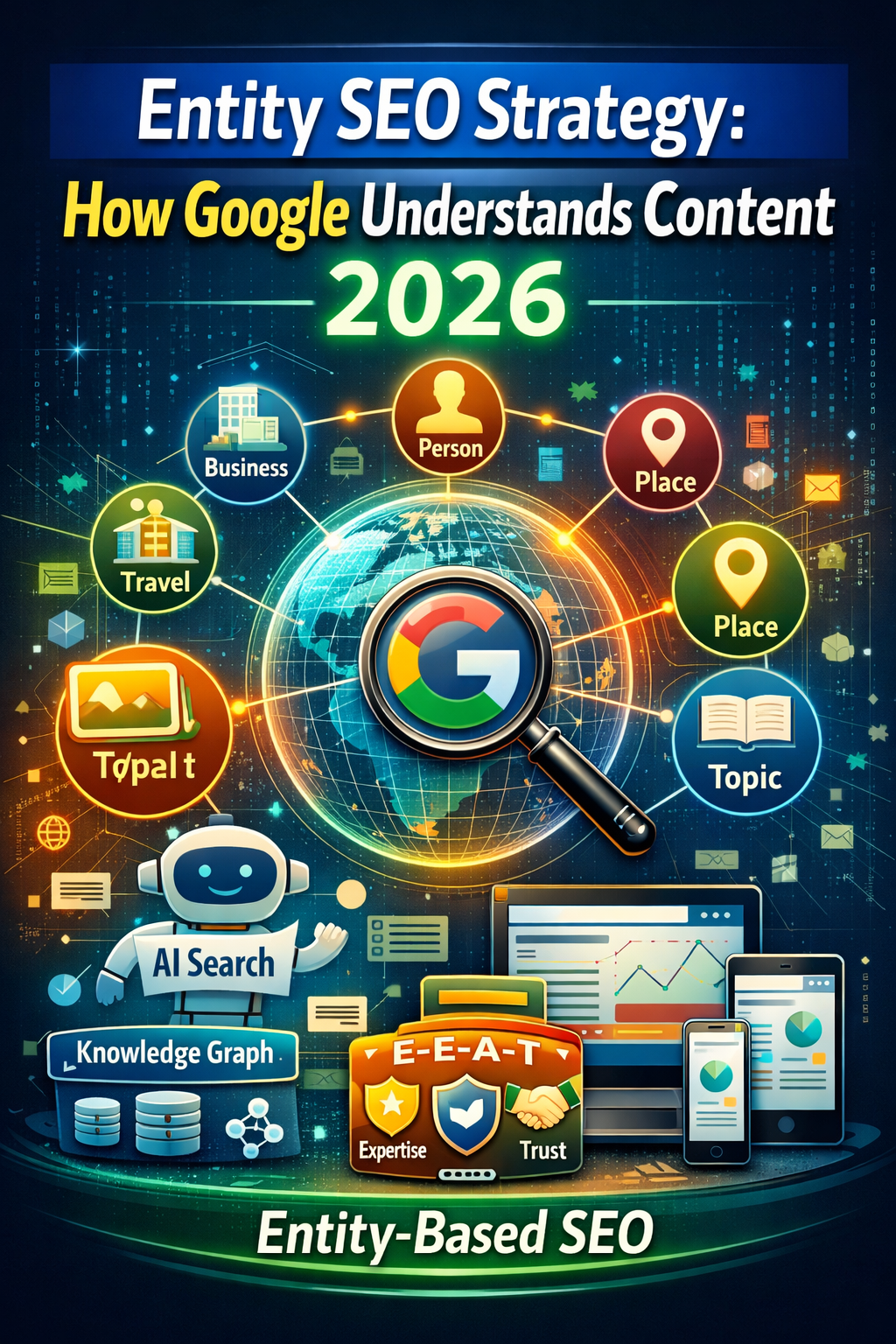
ENTITY SEO STRATEGY focuses on optimizing content around identifiable entities rather than relying only on keywords. An entity can represent a person, location, brand, event, or concept that search engines recognize within their knowledge graph.For example, when Google analyzes content about a travel destination, it identifies entities such as:
Cities and countries
Tourist attractions
Businesses and brands
Historical landmarks
Cultural experiences
By connecting these entities, search engines better understand the context of the content. This approach aligns with the way How Google Understands Content in 2026, where semantic relationships and structured data play a major role in ranking and recommendation systems.
Why Entity-Based Search Matters in 2026
Search engines are increasingly powered by artificial intelligence and natural language processing. These technologies allow search systems to analyze content more intelligently.The shift toward Entity-Based SEO Strategy 2026helps search engines:
Understand the meaning behind user queries
Identify relationships between topics
Provide more accurate search results
Generate AI-driven answers and recommendations
As a result, websites that implement ENTITY SEO STRATEGY are more likely to appear in featured snippets, AI summaries, and knowledge panels.
How Google Understands Content in 2026
To understand How Google Understands Content in 2026, it is important to look at how search algorithms interpret structured information.Google analyzes several elements when evaluating content:
1. Entities and Relationships
Google identifies important entities in the content and analyzes how they relate to each other. For example, in tourism content, entities such as destinations, travel services, and attractions are connected.UsingENTITY SEO STRATEGY, content creators organize information clearly so search engines can identify these relationships.
2. Contextual Meaning
Modern search algorithms focus on context rather than individual keywords. They analyze entire topics and determine whether the content answers user intent effectively.This is why understanding How Google Understands Content in 2026 requires content to be written in a structured and meaningful way.
3. Knowledge Graph Integration
Google’s knowledge graph stores billions of interconnected entities. When websites structure content correctly, search engines can match these entities with existing knowledge graph data.Implementing Entity-Based SEO Strategy 2026 helps websites connect their content to this knowledge network.
4. AI and Generative Search
AI-powered search systems generate summaries and answers directly within search results. These systems rely heavily on entity recognition.Websites using ENTITY SEO STRATEGY are more likely to appear in AI-generated responses.
Key Elements of an Effective Entity SEO Strategy
Organizations aiming to implement ENTITY SEO STRATEGY should focus on several essential components.
1. Clear Topic Structure
Content should be organized around well-defined topics and subtopics. Each section should provide meaningful information that supports the main theme.This structure helps search engines analyze How Google Understands Content in 2026 more effectively.
2. Structured Data and Schema Markup
Structured data allows search engines to recognize entities more accurately. Schema markup provides additional context about businesses, locations, products, and services.Adopting Entity-Based SEO Strategy 2026 often involves implementing schema markup for improved visibility.
3. Topical Authority
Websites that consistently publish high-quality content around a specific topic gain authority. Search engines recognize these websites as reliable sources of information.By applying ENTITY SEO STRATEGY, businesses can strengthen their topical authority within their industry.
4. Internal Linking Between Related Entities
Internal linking helps search engines understand how different pieces of content relate to each other.For example, a website discussing digital marketing may link content related to SEO, AI search, and content strategy. This reinforces How Google Understands Content in 2026 through contextual connections.
Benefits of Entity SEO Strategy
Businesses adopting ENTITY SEO STRATEGY gain several advantages in modern search environments.
Improved Search Visibility
Entity-focused content helps search engines identify relevant information quickly.
Better AI Search Representation
AI search systems rely on structured data and entities to generate answers.
Higher Authority and Trust
Well-structured content signals expertise and credibility, aligning with E-E-A-T principles.
Enhanced User Experience
Content organized around entities provides clearer and more useful information for readers.The implementation of Entity-Based SEO Strategy 2026 allows businesses to adapt to evolving search technologies while maintaining strong digital visibility.
Best Practices for Implementing Entity SEO Strategy
To successfully implement ENTITY SEO STRATEGY, organizations should follow several best practices.
Create Content Around Topics, Not Just Keywords
Focus on comprehensive content that addresses complete topics rather than isolated keywords.
Use Semantic Language
Semantic content helps search engines understand context and meaning, improving How Google Understands Content in 2026.
Build Content Clusters
Create multiple articles related to a central topic and connect them through internal links.
Establish Author Expertise
Including expert insights and credible sources strengthens E-E-A-T signals within content.
Maintain Consistent Entity References
Use consistent names for places, brands, and topics to reinforce entity recognition within search systems.These practices support the long-term effectiveness of Entity-Based SEO Strategy 2026.
Future of Entity SEO
Search technology continues to evolve as AI becomes more sophisticated. The role of entities in search optimization will only increase in importance.Understanding How Google Understands Content in 2026 allows businesses to adapt their strategies and create content that aligns with future search algorithms.By focusing on structured information, contextual relationships, and authoritative content, organizations can successfully implement ENTITY SEO STRATEGY and remain competitive in the evolving digital landscape.
Conclusion
The shift from keyword-focused optimization to entity-based understanding marks a major evolution in search technology. ENTITY SEO STRATEGYprovides a modern framework for organizing content so that search engines and AI systems can interpret it accurately.As digital search becomes increasingly intelligent, understanding How Google Understands Content in 2026 is essential for businesses, marketers, and content creators. Implementing Entity-Based SEO Strategy 2026 ensures that websites remain visible, authoritative, and relevant in an AI-driven search environment.By adopting structured content, semantic optimization, and strong E-E-A-T signals, organizations can position themselves for long-term success in the future of search.
Get a Consultation From
Our Expert
Sanal Edison
(Digital strategist)
Communicate with our experts to bring out better solutions to your problem.


 +91 6282249224


