


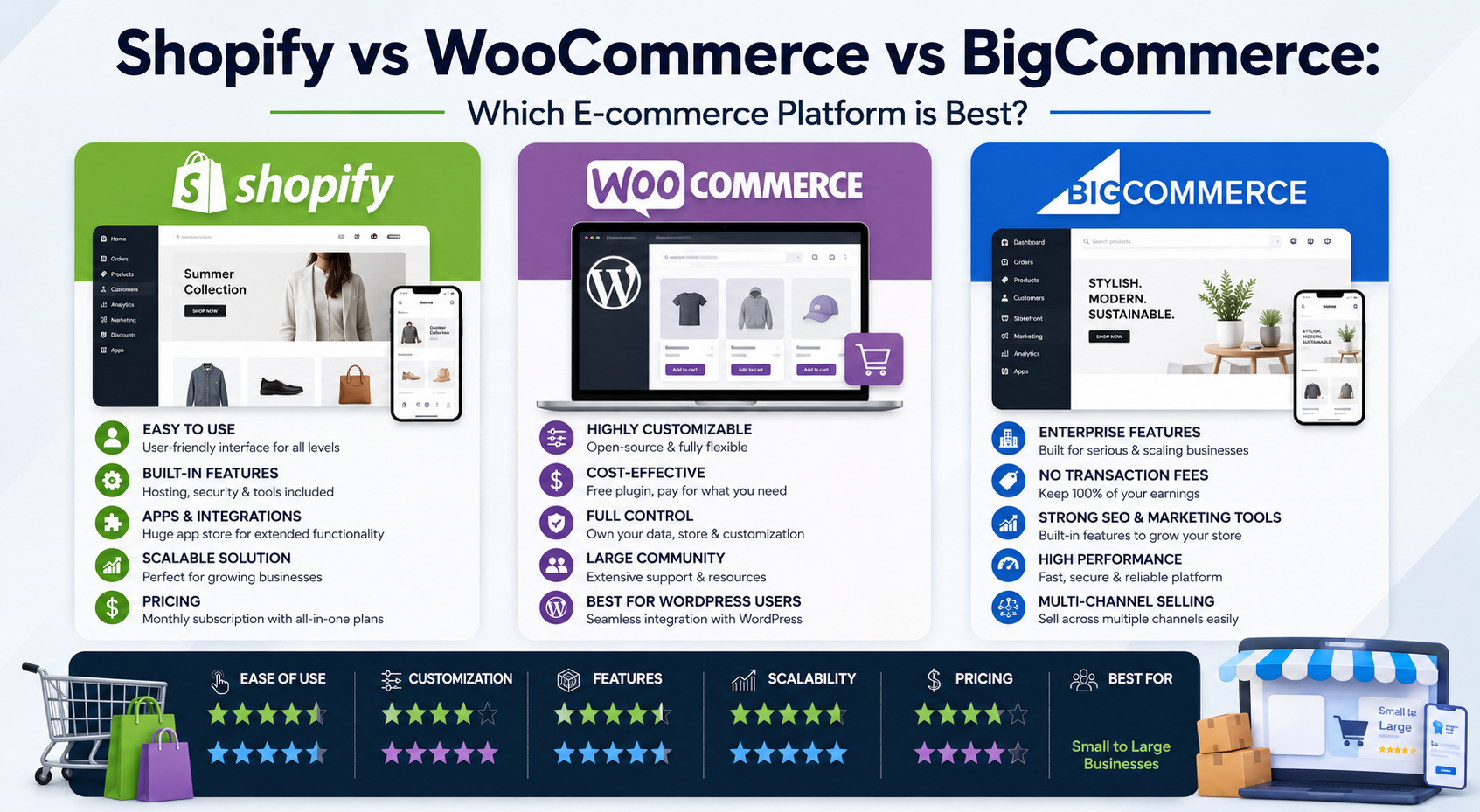
Launching an online store is exciting — until you hit the very first decision that shapes everything else: which platform should actually run it? The Shopify vs WooCommerce vs BigCommerce debate trips up even experienced entrepreneurs, because each platform genuinely excels in different scenarios.
Whether you’re a first-time founder, a growing D2C brand, or an agency advising clients, choosing the wrong platform early can mean costly migrations down the road.
This comprehensive comparison breaks down pricing, SEO capability, scalability, and ease of use across all three platforms, so you can make a confident, informed decision from day one.
Understanding What Sets Each Platform Apart
Before comparing specifics, it helps to understand the core philosophy behind each platform in this Shopify vs WooCommerce vs BigCommerce comparison.
- Shopify — a fully hosted, all-in-one e-commerce platform prioritizing ease of use and fast setup
- WooCommerce — a WordPress plugin offering maximum flexibility and full ownership, requiring more hands-on management
- BigCommerce — a hosted platform positioned between the two, offering strong built-in features for scaling businesses
These foundational differences explain nearly every practical distinction you’ll encounter across pricing, features, and long-term scalability.
Best E-commerce Platform 2026: Why There’s No Single Answer
Searching for the best e-commerce platform 2026 assumes one universal winner exists, but the honest reality is that “best” depends entirely on your business model and growth stage.
Key Questions to Answer First
- Do you want full design and functionality control, or prefer a guided, managed experience?
- What’s your realistic budget for both setup and ongoing costs?
- How complex is your product catalog, and how fast are you scaling?
- Do you have technical resources, or need something manageable without a developer?
- How important is long-term SEO performance versus quick launch speed?
Answering these honestly upfront prevents the common mistake of choosing a platform based on hype rather than actual business fit.
Shopify vs WooCommerce Comparison: Managed Simplicity vs. Full Control
The Shopify vs WooCommerce comparison comes down to one central trade-off: how much do you value convenience versus ownership and customization?
Shopify Strengths
- Fully hosted — no need to manage servers, security, or updates
- Fast setup, often launching stores within days
- Built-in payment processing and extensive app marketplace
- Reliable uptime and performance without technical maintenance
WooCommerce Strengths
- Complete ownership of your store, data, and hosting
- Highly customizable through WordPress’s extensive plugin ecosystem
- No platform transaction fees when using your own payment gateway
- Greater long-term flexibility for complex or unique store requirements
Businesses prioritizing speed and simplicity often choose Shopify, while those wanting deeper customization and full control frequently prefer WooCommerce.
WooCommerce vs BigCommerce Comparison: Flexibility vs. Built-In Power
The WooCommerce vs BigCommerce comparison highlights a different kind of trade-off — customization freedom versus robust features available immediately out of the box.
WooCommerce Advantages
- Nearly unlimited customization through WordPress themes and plugins
- Full content ownership, ideal for content-driven or blog-integrated stores
- Lower baseline costs for simple stores
BigCommerce Advantages
- Stronger built-in features (multi-channel selling, B2B tools) without needing extra plugins
- No plugin dependency for core e-commerce functionality, reducing maintenance overhead
- Better native scalability for larger catalogs without performance degradation
BigCommerce often appeals to businesses wanting powerful features without managing dozens of plugins, while WooCommerce suits those wanting granular control over every element.
Shopify vs BigCommerce Comparison: Two Hosted Platforms Compared
Since both are fully hosted, the Shopify vs BigCommerce comparison focuses more on feature depth and pricing structure than on hosting responsibility.
Shopify Wins When You Need:
- The largest app marketplace and most extensive third-party integrations
- A more polished, beginner-friendly interface
- Strong brand recognition and ecosystem support
BigCommerce Wins When You Need:
- More robust built-in features without relying heavily on paid apps
- Better native support for complex product catalogs and B2B functionality
- No forced upgrade to higher tiers simply for basic features Shopify sometimes gates behind apps
Both platforms handle hosting and security, making this comparison more about feature philosophy than technical management.
Shopify vs WooCommerce vs BigCommerce Pros and Cons: Full Breakdown
Here’s a comprehensive Shopify vs WooCommerce vs BigCommerce pros and cons table covering the factors that matter most to store owners.
| Factor | Shopify | WooCommerce | BigCommerce |
|---|---|---|---|
| Ease of use | Very easy | Moderate learning curve | Easy to moderate |
| Hosting management | Fully managed | Self-managed (or via host) | Fully managed |
| Design flexibility | High (via themes/apps) | Extremely high | High |
| Built-in features | Good, app-dependent | Requires plugins | Strong out of the box |
| Ownership | Platform-hosted | Full ownership | Platform-hosted |
| Best for | Fast launch, DTC brands | Custom, content-driven stores | Scaling B2B/B2C catalogs |
No platform dominates every category — your specific priorities determine which trade-offs matter most for your business.
Shopify vs WooCommerce vs BigCommerce Features: Core Capability Comparison
Diving deeper into Shopify vs WooCommerce vs BigCommerce features, several core capabilities deserve closer examination beyond surface-level comparison.
Checkout and Payment Processing
- Shopify — Shopify Payments built-in, with additional fees for third-party gateways
- WooCommerce — flexible gateway integration (Razorpay, Stripe, PayPal) with no platform transaction fees
- BigCommerce — multiple built-in payment options with no forced transaction fees on external gateways
Multi-Channel Selling
- Shopify — extensive integrations with social platforms and marketplaces
- WooCommerce — requires plugins for multi-channel functionality
- BigCommerce — strong native multi-channel capability built into core platform
Our team’s experience across WooCommerce, Shopify, and multi-platform e-commerce development in Kochi consistently shows that feature needs, more than brand preference, should drive this decision.
E-commerce Platform Pricing Comparison: What You’ll Actually Pay
Understanding realistic e-commerce platform pricing comparison figures prevents budget surprises once you move past introductory pricing tiers.
General Pricing Patterns
- Shopify — monthly subscription plus transaction fees (reduced or waived with Shopify Payments)
- WooCommerce — the plugin itself is free, but hosting, premium themes, and extensions add ongoing costs
- BigCommerce — monthly subscription based on sales volume tiers, with no forced transaction fees
Shopify and BigCommerce offer more predictable monthly costs, while WooCommerce’s total cost depends heavily on hosting quality and plugin choices.
E-commerce Platform Cost Comparison: Total Cost of Ownership
Beyond monthly subscriptions, understanding e-commerce platform cost comparison over time requires factoring in hidden costs across all three platforms.
Hidden Cost Factors to Consider
- Transaction fees — Shopify charges extra unless using their native payment gateway
- Apps and plugins — functionality add-ons carry recurring fees on all three platforms
- Theme customization — premium themes or custom design work add upfront costs
- Hosting — WooCommerce requires separate hosting costs; Shopify and BigCommerce include this
- Developer support — complex customizations may require professional development regardless of platform
Businesses scaling quickly often find BigCommerce’s included features reduce reliance on paid apps compared to Shopify, lowering total cost as the store grows.
Shopify vs WooCommerce for SEO: Which Platform Ranks Better?
For businesses prioritizing organic traffic, understanding Shopify vs WooCommerce for SEO capability significantly impacts long-term growth potential.
WooCommerce SEO Advantages
- Full access to WordPress’s extensive SEO plugin ecosystem
- Greater control over URL structure, site architecture, and technical SEO elements
- Stronger native blogging integration for content marketing strategies
Shopify SEO Considerations
- Has improved significantly with built-in SEO tools and apps
- Some URL structure limitations compared to WooCommerce’s flexibility
- Strong site speed and uptime, both indirect SEO ranking factors
For content-heavy e-commerce strategies specifically, WooCommerce’s WordPress foundation generally offers more granular SEO control, though Shopify has substantially closed this gap in recent years.
Best Scalable E-commerce Platform: Planning for Growth
Determining the best scalable e-commerce platform for your business depends on what “scaling” actually means for your specific growth trajectory.
Scalability Considerations by Platform
- Shopify — scales well through Shopify Plus for high-volume enterprise stores, though costs increase significantly at that tier
- WooCommerce — scalability depends heavily on hosting quality and proper technical optimization as traffic grows
- BigCommerce — built with scalability in mind from smaller plans through enterprise tiers, with strong native performance at scale
Businesses anticipating rapid, significant growth often lean toward BigCommerce or Shopify Plus, while WooCommerce requires more proactive technical management to scale smoothly.
Best Platform for Dropshipping: What Dropshippers Actually Need
For dropshipping and D2C brand founders, evaluating the best platform for dropshipping requires focusing on specific integration and automation capabilities.
Dropshipping-Specific Considerations
- Shopify — largest ecosystem of dropshipping-specific apps (automated order fulfillment, supplier integrations)
- WooCommerce — dropshipping plugins available, though generally less streamlined than Shopify’s dedicated app ecosystem
- BigCommerce — supports dropshipping through apps, though the ecosystem is smaller than Shopify’s
Shopify’s mature dropshipping app ecosystem gives it a practical edge for entrepreneurs specifically building dropshipping-based businesses.
E-commerce Platform for Small Business: Making the Right Call
For most small businesses, determining the right e-commerce platform for small business needs comes down to balancing immediate simplicity against future growth plans.
Quick Decision Framework
- Need fast launch with minimal technical effort? → Shopify
- Want full ownership and content-driven flexibility? → WooCommerce
- Need strong built-in features without heavy app dependency? → BigCommerce
- Running a content-heavy brand alongside your store? → WooCommerce
Our e-commerce website development services in Kochi team regularly guides small businesses through this exact decision based on their specific catalog size, budget, and growth goals.
Easiest E-commerce Platform for Beginners: Removing the Learning Curve
For complete beginners, understanding the easiest e-commerce platform for beginners helps set realistic expectations before launch.
Beginner-Friendliness Ranking
- Shopify — most streamlined setup experience, minimal technical knowledge required
- BigCommerce — slightly more configuration involved, still approachable for non-technical users
- WooCommerce — steeper learning curve, requiring basic WordPress familiarity
Beginners prioritizing speed to launch typically start with Shopify, while those anticipating long-term content marketing integration increasingly invest time learning WooCommerce fundamentals.
Which Online Store Platform Is Best: Final Decision Framework
Ultimately, answering which online store platform is best requires matching platform strengths to your specific business model, rather than chasing a single universal answer.
Choose Shopify If:
- You want the fastest path from idea to live store
- You’re running a dropshipping or DTC brand needing extensive app integrations
- You prefer fully managed hosting without technical maintenance
Choose WooCommerce If:
- Content marketing and blogging are central to your growth strategy
- You want complete ownership and maximum customization freedom
- You have access to development support for ongoing optimization
Choose BigCommerce If:
- You need robust built-in features without excessive app dependency
- You’re scaling toward complex B2B or large-catalog requirements
- You want strong native performance without heavy technical management
Frequently Asked Questions
1. Which platform is cheapest for a small store just starting out?
WooCommerce often has the lowest baseline cost for simple stores, though Shopify and BigCommerce offer more predictable all-inclusive monthly pricing as you scale.
2. Is WooCommerce harder to set up than Shopify?
Yes, WooCommerce requires basic WordPress familiarity and more hands-on setup, while Shopify offers a more guided, beginner-friendly launch experience.
3. Which platform is best for SEO and content marketing?
WooCommerce generally offers stronger SEO customization through WordPress’s plugin ecosystem, particularly for businesses combining blogging with e-commerce.
4. Can I switch platforms later if my business outgrows my current choice?
Yes, though migration can be time-consuming and costly — choosing a platform aligned with your long-term growth plans from the start helps avoid this.
5. Which platform is best suited for dropshipping specifically?
Shopify has the most mature ecosystem of dropshipping-specific apps and supplier integrations, giving it a practical edge for dropshipping-focused businesses.
Final Thoughts
There’s no single winner in the Shopify vs WooCommerce vs BigCommerce comparison — only the platform that best matches your business model, budget, and growth trajectory. Understanding these genuine trade-offs upfront helps you build an online store that scales with your business, not against it.
Not sure which e-commerce platform fits your business? Visit the Teknoppy to explore our e-commerce development services, or request a free consultation for personalized platform guidance tailored to your store.

 +91 6282249224