
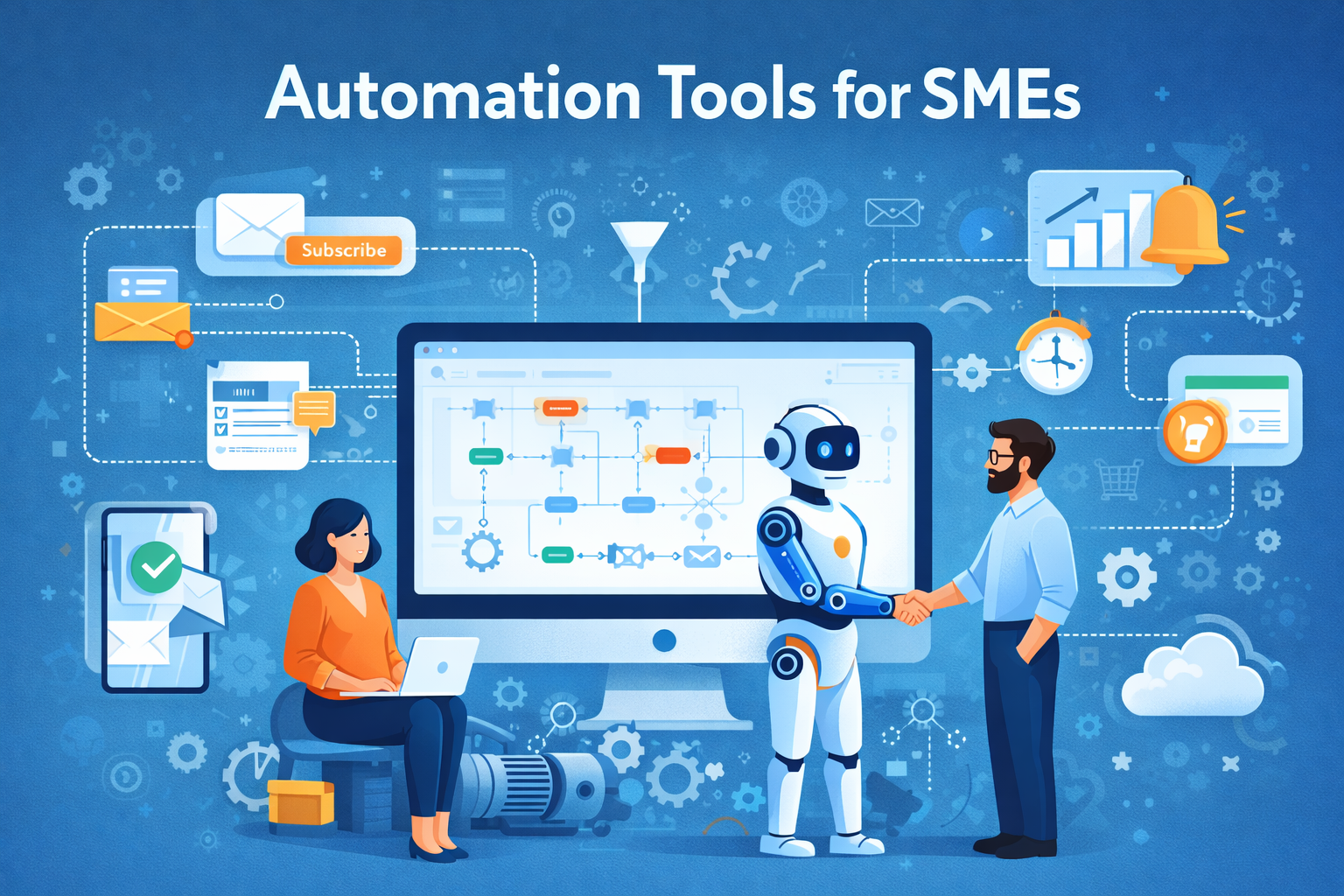
Automation Tools for SMEs are transforming how small and medium-sized enterprises operate by reducing manual workload, improving efficiency, and enabling faster decision-making. In today’s competitive global economy, businesses must adopt smart technologies to remain productive and scalable. This guide explains how automation enhances productivity, the types of tools available, and how SMEs across domestic and international markets can benefit from digital transformation.
Small and medium enterprises often operate with limited resources, smaller teams, and tight budgets. Manual processes consume time and increase the risk of errors, which directly impacts productivity and profitability. Automation Tools for SMEs help streamline operations by replacing repetitive tasks with technology-driven workflows.
Key reasons SMEs adopt automation include:
Companies investing in SME Productivity Automation gain a competitive advantage because automation allows teams to focus on strategic and revenue-generating activities rather than routine administrative work.
Automation Tools for SMEs are software solutions designed to perform tasks automatically with minimal human intervention. These tools integrate business processes such as marketing, finance, customer management, and operations into streamlined workflows.
Examples include:
Business Automation for Small Businesses is no longer limited to large corporations; affordable cloud-based solutions make automation accessible for startups and growing companies worldwide.
Automation Tools for SMEs eliminate repetitive activities such as data entry, email responses, and reporting. This significantly reduces human effort and allows employees to focus on higher-value tasks.
SME Productivity Automation improves workflow speed while minimizing human error, which leads to better operational efficiency.
Time is one of the most valuable resources for SMEs. Automation helps schedule tasks, send reminders, and manage deadlines efficiently. Teams can prioritize strategic activities rather than administrative work.
Business Automation for Small Businesses ensures consistent task execution without delays, improving overall time utilization.
Human errors in accounting, data entry, and reporting can lead to financial losses and operational inefficiencies. Automation Tools for SMEs ensure standardized processes and accurate data handling, reducing mistakes significantly.
Accurate reporting also supports better business decisions and forecasting.
Automation platforms integrate communication tools that improve collaboration between departments and remote teams. Automated notifications, task tracking, and shared dashboards create transparency and accountability.
SME Productivity Automation helps teams stay aligned and improves project execution efficiency.
Customer satisfaction directly impacts business growth. Automation Tools for SMEs enable faster responses, personalized communication, and consistent service delivery.
Examples include:
Business Automation for Small Businesses improves customer engagement and retention while reducing workload on support teams.
Automation Tools for SMEs provide benefits across multiple business functions:
Automates email campaigns, social media posting, and lead nurturing processes, improving marketing ROI and conversion rates.
Tracks leads, manages pipelines, and automates follow-ups, helping sales teams close deals faster.
Simplifies invoicing, payroll, expense tracking, and tax calculations, reducing administrative burden.
Improves inventory management, order processing, and supply chain coordination.
Streamlines recruitment, attendance tracking, employee onboarding, and performance management.
SME Productivity Automation across these functions creates a more efficient business ecosystem.
Automation Tools for SMEs offer advantages regardless of business location. Domestic companies benefit from cost savings and efficiency improvements, while international SMEs gain scalability and global competitiveness.
Major benefits include:
Business Automation for Small Businesses enables companies to compete with larger organizations by leveraging technology.
While automation provides significant benefits, SMEs may encounter challenges such as:
However, proper planning and choosing scalable Automation Tools for SMEs can overcome these challenges effectively.
To maximize productivity improvements, SMEs should follow these best practices:
SME Productivity Automation works best when aligned with business goals and employee adoption strategies.
The future of Automation Tools for SMEs is driven by artificial intelligence, machine learning, and cloud technologies. Emerging trends include:
Business Automation for Small Businesses will continue to evolve, making technology more accessible and affordable for companies worldwide.
Automation Tools for SMEs are essential for improving productivity, reducing operational costs, and enabling sustainable business growth. By automating repetitive tasks, improving communication, and enhancing customer experiences, SMEs can operate more efficiently and competitively in both domestic and international markets. Investing in SME Productivity Automation and Business Automation for Small Businesses is no longer optional — it is a strategic necessity for future success.

Communicate with our experts to bring out better solutions to your problem.
 +91 6282249224
This will close in 0 seconds


