
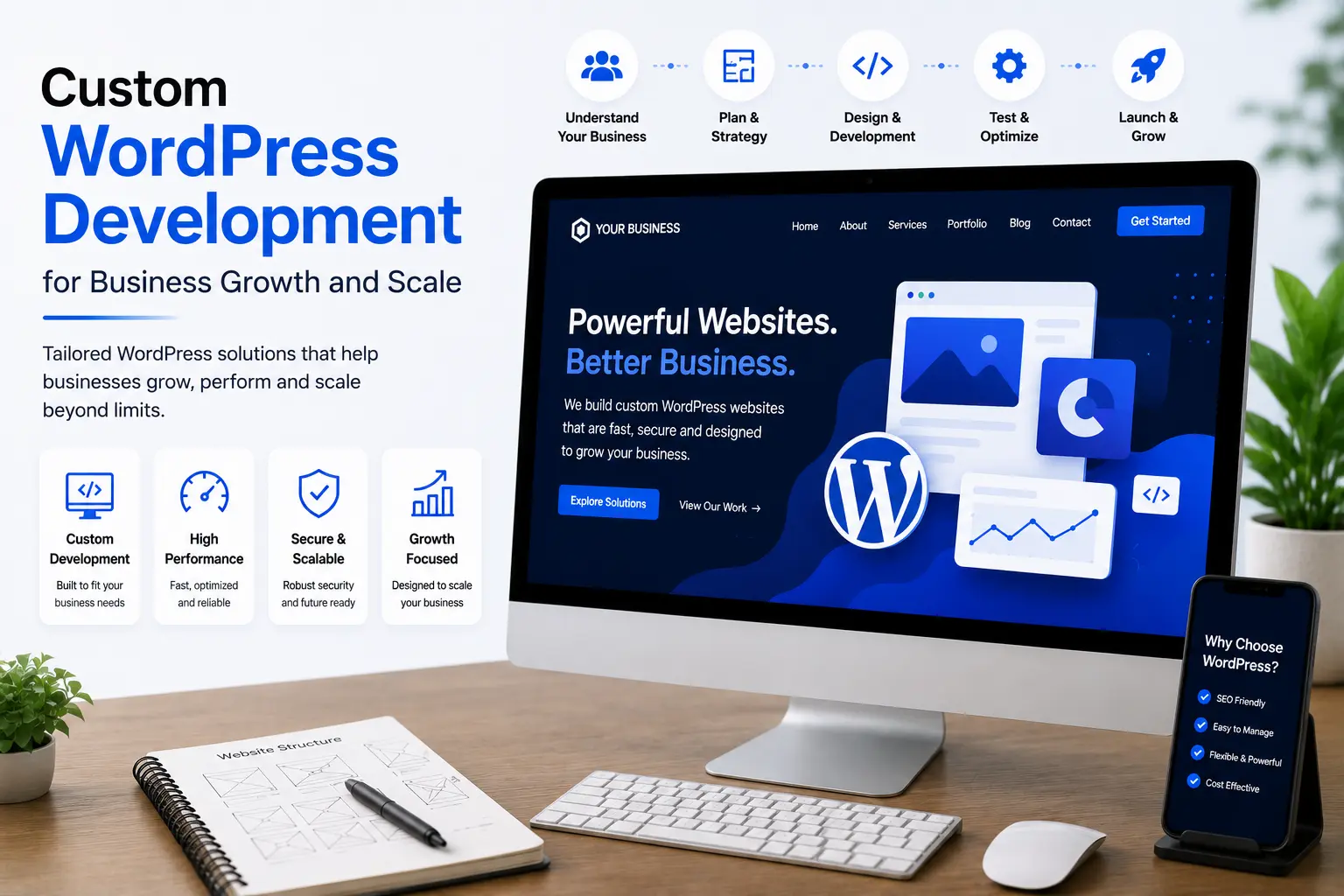
A generic theme can get a business online, but it rarely supports growth once traffic, product lines, or customer expectations increase. Custom WordPress development closes that gap by building a site around your actual business needs instead of forcing your business into a template’s limitations. This guide covers what custom WordPress development involves, why it matters for scaling businesses, and how to know when it’s the right investment.
Custom WordPress development means building a website on the WordPress platform using bespoke themes, custom functionality, and purpose-built plugins rather than relying entirely on off-the-shelf templates. It keeps the flexibility and content management ease WordPress is known for while removing the constraints that stock themes impose on design, performance, and features. This makes it a strong middle ground between fully templated sites and building a platform from scratch.
WordPress powers a large share of the web because it balances flexibility with a manageable learning curve, and that flexibility is exactly what supports WordPress development for business growth. As a business adds products, service pages, locations, or content, a custom-built WordPress site can extend cleanly through custom post types, tailored taxonomies, and purpose-built plugins instead of forcing workarounds into a rigid template. This adaptability is why growing businesses increasingly move away from basic themes toward tailored builds.
A template gets you live quickly, but custom WordPress website design gives you a site engineered around your brand, user flow, and conversion goals from the start. Templates often carry unused code, generic layouts, and design compromises that hurt both user experience and page speed. A custom build strips out what you don’t need and structures the site specifically around how your customers actually browse and buy, which compounds into better performance over time.
Scalable WordPress solutions are built with future growth in mind rather than only solving today’s requirements. This includes choosing hosting infrastructure that can handle traffic spikes, structuring the database and codebase to support new features without a rebuild, and selecting plugins that won’t create conflicts as the site expands. Businesses that plan for WordPress website scalability early avoid the costly full rebuilds that often hit companies who outgrow a basic setup within a year or two.
Off-the-shelf plugins cover common needs, but unique business processes often require custom WordPress plugin development to work properly. This might mean a custom booking system, a specialized product configurator, or an integration with internal business software that no marketplace plugin handles well. Custom plugins also reduce the bloat and security risk that comes from stacking multiple third-party plugins to approximate functionality that a single purpose-built tool could handle more efficiently.
Enterprise WordPress development introduces additional requirements around security, uptime, multi-user workflows, and integration with existing business systems like CRMs or ERPs. At this scale, custom development typically includes staging environments, rigorous testing pipelines, role-based access controls, and performance monitoring built directly into the deployment process. Businesses operating at this level need a WordPress development company experienced with large-scale builds rather than a generalist working from templates.
The WordPress vs custom CMS decision usually comes down to trade-offs between speed of development, ongoing flexibility, and long-term cost. WordPress, especially when custom-built, gives businesses a mature ecosystem, easier content management for non-technical staff, and lower development costs than a fully custom CMS. A fully custom CMS may make sense for highly specialized platforms, but for most growing businesses, custom WordPress development delivers comparable flexibility at a fraction of the cost and timeline. For a closer look at how WordPress stacks up against other popular platforms, our comparison on WordPress vs Wix vs Squarespace breaks down the options in more detail.
As traffic and content grow, WordPress performance optimization becomes essential to keep pages fast and search rankings strong. Core practices include image optimization, caching, a lean plugin stack, and a hosting environment matched to actual traffic needs rather than a generic shared plan. Regular performance audits catch slowdowns before they affect conversions, and this is an area where custom-built sites have a real advantage since there is no unnecessary template code weighing the site down.
Many businesses start with a DIY WordPress site and reach a point where growth outpaces what a non-technical owner can maintain safely. Signs it’s time to hire WordPress developers include recurring plugin conflicts, slow page speeds that resist basic fixes, security concerns, or a need for functionality no existing plugin supports well. At that stage, working with an established web design company in Kochi ensures the rebuild is done with scalability in mind rather than repeating the same limitations in a new theme.
A well-built custom WordPress site becomes an asset that supports marketing, sales, and operations together rather than just serving as a digital brochure. It can integrate cleanly with eCommerce functionality for businesses that sell online, support ongoing digital marketing campaigns through flexible landing pages, and scale alongside SEO efforts without structural rework. This is what separates a site that merely looks good from one that actively contributes to growth.
What is the difference between WordPress and custom WordPress development? Standard WordPress often relies on pre-built themes and plugins, while custom WordPress development involves building tailored themes, functionality, and plugins specific to a business’s needs.
Is custom WordPress development more expensive than using a template? It typically costs more upfront than a template, but it reduces long-term costs by avoiding plugin conflicts, performance issues, and eventual rebuilds that templates often require.
Can WordPress handle enterprise-level traffic and scale? Yes, with the right hosting infrastructure, caching strategy, and custom development approach, WordPress can support enterprise-level traffic and complex business requirements.
How do I know if I need a custom WordPress plugin? If your business process cannot be handled well by existing plugins, or requires stacking several plugins to approximate a single function, a custom WordPress plugin is usually the better long-term solution.
Should a growing business choose WordPress or a custom CMS? For most growing businesses, custom WordPress development offers the flexibility of a custom CMS at a lower cost and faster timeline, making it the practical choice outside of highly specialized use cases.
Custom WordPress development gives growing businesses the flexibility of a tailored platform without the cost and complexity of building a CMS from scratch. From custom plugin development to performance optimization and enterprise-level scalability, a properly built WordPress site becomes infrastructure that supports growth rather than limiting it. If your current site is holding your business back, Teknoppy’s WordPress development team can assess what a custom build would look like for your specific goals.

Communicate with our experts to bring out better solutions to your problem.
 +91 6282249224
This will close in 0 seconds


