
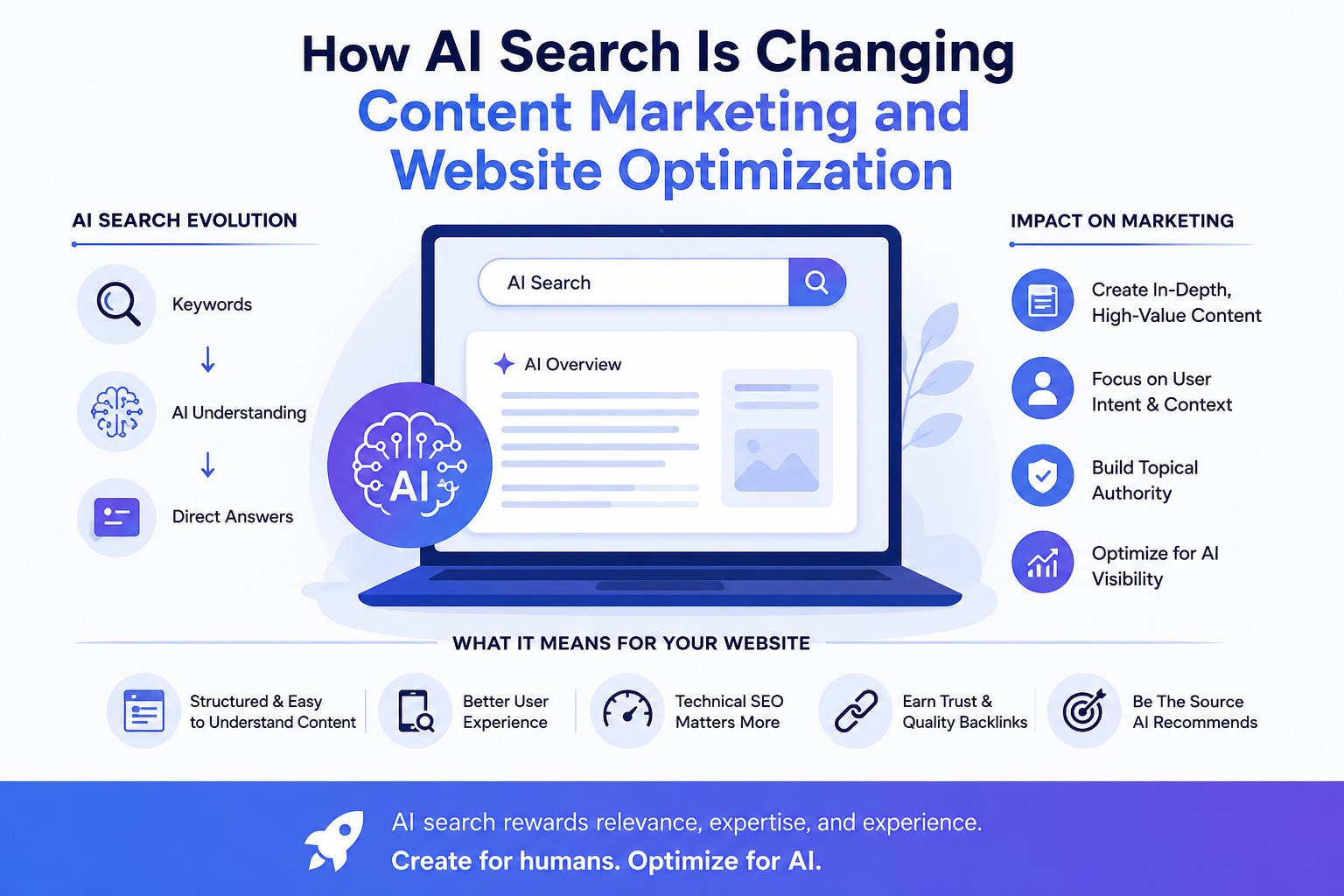
The way people search for information has fundamentally shifted. AI search and content marketing are now deeply intertwined, as tools like ChatGPT, Google AI Overviews, and Perplexity answer questions directly, often without sending users to a website at all. For business owners, startups, and SMEs in Kochi and across India, this shift means that ranking on page one of Google is no longer enough.
If your content strategy was built entirely around traditional keyword targeting and backlinks, you may already be losing visibility in AI-generated answers. This article breaks down exactly what’s changing, why it matters, and how to adapt your content marketing strategy for AI search before your competitors do.
Traditional search engines return a list of links ranked by relevance and authority. AI search engines, by contrast, generate a synthesized answer pulled from multiple sources, often presenting it before any links appear at all.
This means:
For businesses investing in SEO services in Kochi, this represents both a challenge and an opportunity. The websites that adapt early will capture visibility that competitors are still ignoring.
A content marketing strategy for AI search looks different from one built purely for Google’s traditional algorithm. Here’s what’s changing:
AI engines favor content that answers a question clearly and concisely, often within the first few sentences. Stuffing keywords no longer helps; clarity does.
Content broken into clear headings, short paragraphs, bullet points, and FAQs is far easier for AI models to parse and extract. Walls of unstructured text get overlooked.
AI models are trained to prefer sources that demonstrate real expertise. This is where E-E-A-T (Experience, Expertise, Authoritativeness, Trustworthiness) becomes critical. Author bios, case studies, and original insights all help establish this.
AI search tools pull information from a wide range of sources, not just your website. A strong content writing service in Kochi can help ensure your brand voice and key facts are consistent across blogs, service pages, and third-party mentions.
Optimizing a website for AI search builds on solid SEO fundamentals but adds new layers. Here are the practical steps businesses should take:
Each H2 and H3 should function almost like a question a user might ask. This makes it easy for AI models to extract relevant sections as direct answers.
Schema markup helps search engines and AI tools understand what your content is about. FAQ schema, in particular, increases the chances of your content being featured in AI-generated responses and Google’s “People Also Ask” sections.
Site speed, mobile responsiveness, and clean URL structures remain foundational. AI crawlers, like traditional crawlers, struggle with slow or poorly coded sites. If your website hasn’t been audited recently, working with a team that handles both web development and SEO together ensures these technical and content elements work in sync.
Despite the rise of AI search, content still needs to genuinely help readers. AI models are increasingly good at detecting low-value, AI-generated filler content and tend to deprioritize it.
Freshness signals matter. Outdated statistics or references can cause AI models to skip your content in favor of more recent sources. Regularly auditing and updating older blog posts is now a core part of any content marketing strategy for AI search.
Google’s E-E-A-T framework (Experience, Expertise, Authoritativeness, Trustworthiness) has become even more important in the AI search era. AI models are trained to reduce the spread of low-quality or misleading information, which means they actively favor content that demonstrates:
Businesses that have built a strong reputation through consistent, expert-led content, like the kind highlighted in Teknoppy’s SEO case studies, are better positioned to be cited as trusted sources by AI search engines.
Local businesses in Kochi face a unique opportunity. AI search tools increasingly handle location-based queries, such as “best web development company near me” or “digital marketing agency in Kochi,” by pulling from Google Business Profiles, reviews, and locally relevant content.
To stay visible:
At Teknoppy, we work with businesses across Kochi to align their social media marketing, content, and website strategies, so they show up consistently across every channel AI tools draw from.
SEO isn’t disappearing, it’s evolving. The fundamentals of good content, technical performance, and trust signals remain the same. What’s changed is the audience: you’re no longer optimizing only for human readers and search engine crawlers, but also for AI systems that summarize and recommend content on your behalf.
Businesses that treat AI search and content marketing as separate from traditional SEO will fall behind. Those that integrate both into a single strategy, supported by strong WordPress development and ongoing content updates, will be the ones AI tools recommend to potential customers.
1. What is AI search and how is it different from Google search? AI search refers to tools like ChatGPT, Google AI Overviews, and Perplexity that generate direct, summarized answers to user queries, often without requiring a click to a website. Traditional Google search primarily returns ranked links for users to explore.
2. Do I still need SEO if AI search is becoming popular? Yes. AI search optimization for websites builds on traditional SEO fundamentals, including site speed, mobile-friendliness, and quality content. Without strong SEO foundations, AI tools have nothing reliable to draw from.
3. How can small businesses in Kochi optimize for AI search? Small businesses should focus on clear, well-structured content, updated Google Business Profiles, FAQ sections, and locally relevant case studies. Working with an experienced local agency can speed up this process significantly.
4. What role does content quality play in AI search rankings? A major one. AI models are designed to filter out thin or repetitive content and prioritize sources that demonstrate genuine expertise and original insight, making E-E-A-T more important than ever.
5. How often should I update my website content for AI search optimization? Reviewing and updating key pages and blog posts every 3 to 6 months helps maintain freshness signals, which both traditional and AI-driven search systems use to evaluate relevance.
AI search and content marketing are no longer separate disciplines, they’re converging into a single strategy that businesses can’t afford to ignore. By focusing on clear structure, genuine expertise, technical performance, and consistent local signals, businesses in Kochi and beyond can position themselves to be visible, cited, and trusted in this new search landscape.
If you’re ready to future-proof your website and content strategy for AI search, get in touch with Teknoppy today, Kochi’s trusted partner for SEO, web development, and digital growth.

Communicate with our experts to bring out better solutions to your problem.
 +91 6282249224
This will close in 0 seconds


