
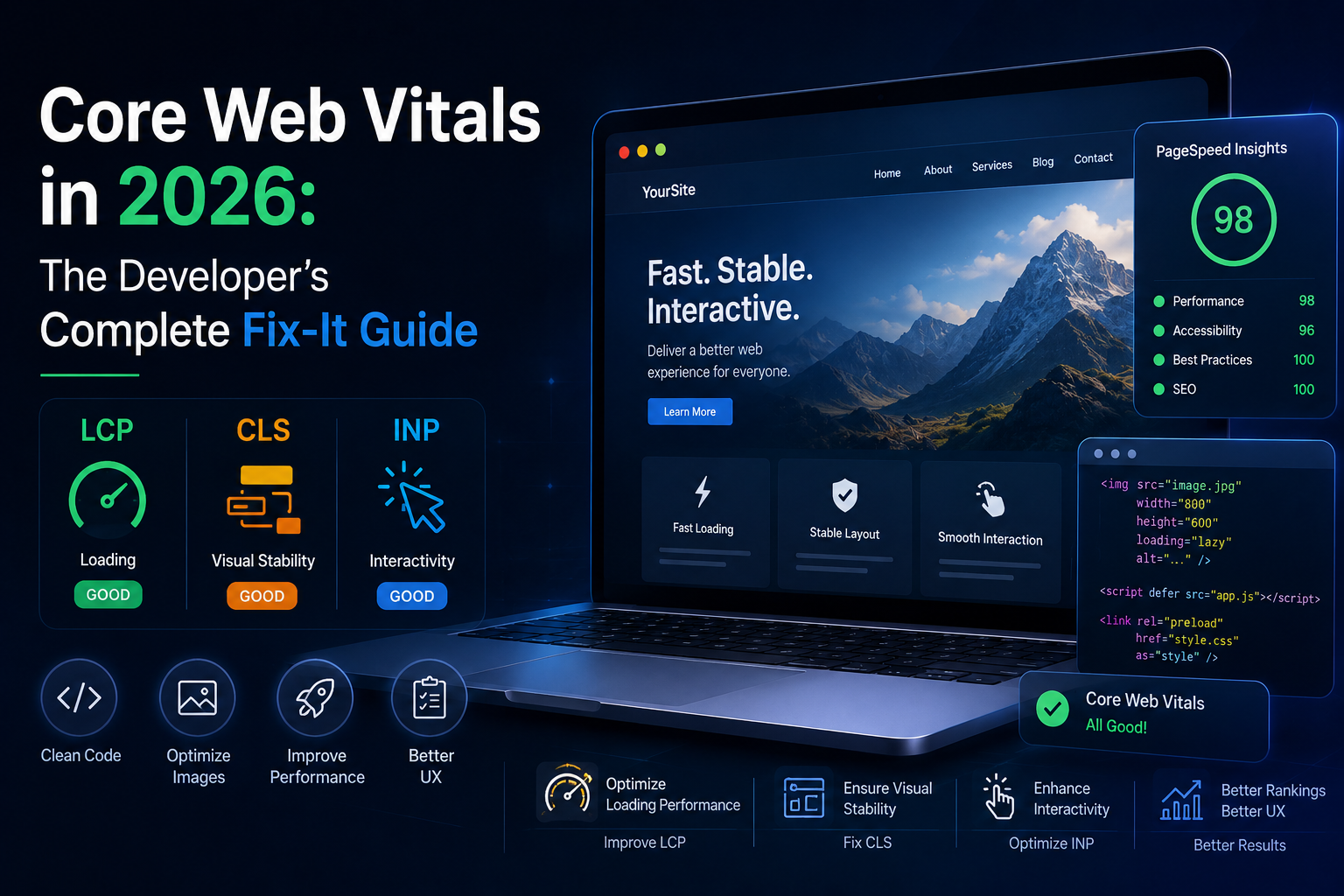
Core Web Vitals optimization for LCP CLS and INP in 2026 has become one of the most critical technical priorities for every web developer, digital marketer, and business owner who depends on organic search traffic. Google has made it unmistakably clear — page experience is a confirmed ranking factor, and the three metrics at the heart of that experience are Largest Contentful Paint, Cumulative Layout Shift, and Interaction to Next Paint. If your website is failing any one of these three signals, you are losing rankings, losing visitors, and ultimately losing revenue to competitors who have made the investment to fix them.
This guide is written for domestic and international developers, agency teams, and technically minded business owners who want clear, actionable, and expertly grounded solutions.
Why Core Web Vitals Matter for SEO Rankings in 2026
Understanding the stakes is the first step toward prioritising the right fixes.
How Core Web Vitals Affect Google Search Ranking in 2026
Why Core Web Vitals matter for SEO rankings in 2026 goes beyond a simple algorithmic checkbox. Google’s page experience signals are now deeply integrated into how the search algorithm evaluates the quality and trustworthiness of a webpage. A site that loads slowly, shifts unexpectedly during scrolling, or responds sluggishly to user interactions sends clear negative quality signals — regardless of how strong its content or backlink profile may be.
How Core Web Vitals affect Google search ranking in 2026 is measurable and direct. Websites that consistently score in the Good range across all three metrics benefit from stronger ranking eligibility in competitive search results. For international businesses targeting multiple markets and domestic brands competing in high-traffic niches, the performance gap between a passing and failing Core Web Vitals score can represent a significant difference in organic visibility and monthly traffic volume.
Understanding the Three Core Web Vitals Metrics
Before fixing the problems, every developer needs a precise understanding of what each metric measures and what the current passing thresholds require.
What Is LCP and How to Improve Largest Contentful Paint Score Fast
Largest Contentful Paint measures how long it takes for the largest visible element on the page — typically a hero image, banner, or large heading — to fully render in the user’s viewport. The passing threshold in 2026 remains under 2.5 seconds. Anything between 2.5 and 4 seconds needs improvement, and anything above 4 seconds is considered poor.
How to improve Largest Contentful Paint score fast requires targeting the most common causes directly. Slow server response times are the leading culprit — addressed through upgrading hosting infrastructure, implementing a Content Delivery Network, and enabling HTTP/2 or HTTP/3 protocols. LCP optimization for images and server response time involves compressing images to modern formats such as WebP or AVIF, implementing lazy loading for below-the-fold images only, and preloading the LCP element using the rel equals preload link tag in the document head.
How to fix LCP issues in 2026 for better Google rankings also means eliminating render-blocking resources — CSS and JavaScript files that delay the browser from painting the page. Deferring non-critical JavaScript, inlining critical CSS, and removing unused third-party scripts are the three most impactful technical interventions available to any developer working on LCP improvement.
What Is INP and How to Improve It for Core Web Vitals
What is INP and how to improve it for Core Web Vitals is now one of the most searched developer questions globally since INP officially replaced First Input Delay as a Core Web Vital in March 2024. Interaction to Next Paint measures the full visual response time from when a user interacts with a page element — a click, tap, or keyboard input — to when the browser visually updates in response. The passing threshold is under 200 milliseconds.
Interaction to Next Paint optimization techniques for developers centre on reducing main thread blocking. Long JavaScript tasks that exceed 50 milliseconds on the main thread are the primary cause of poor INP scores. Breaking up long tasks using scheduler dot yield, reducing the size and complexity of JavaScript event handlers, avoiding synchronous third-party scripts, and deferring analytics and tag manager payloads are the most effective technical approaches available in 2026.
INP vs FID difference and what changed for developers is an important context point for any developer still calibrating their mental model. FID measured only the delay before the browser began processing the first interaction — it ignored processing time and visual update time entirely. INP measures the complete interaction latency across all interactions throughout the page session, making it a far more comprehensive and demanding performance standard.
CLS Fix for Websites Causing Layout Shift in 2026
Cumulative Layout Shift measures visual stability — specifically how much page content unexpectedly moves during loading and interaction. The passing threshold is a CLS score below 0.1. Layout shifts are among the most frustrating user experiences on any device, particularly on mobile screens where displaced content causes accidental clicks and disrupted reading.
CLS fix for websites causing layout shift in 2026 begins with reserving explicit size dimensions for all images, videos, iframes, and advertisement containers. When the browser knows the dimensions of an element before it loads, it reserves the space in advance — eliminating the shift entirely. How to reduce Cumulative Layout Shift on WordPress sites specifically involves auditing theme templates for unsized media elements, disabling layout-shifting ad networks, and ensuring web fonts load with font-display swap to prevent invisible text causing reflow during font substitution.
Core Web Vitals Tools to Measure and Fix Website Performance
Real User Monitoring vs Lab Data for Core Web Vitals Testing
Core Web Vitals tools to measure and fix website performance fall into two distinct categories that every developer must understand before interpreting results accurately.
Real user monitoring vs lab data for Core Web Vitals testing is a critical distinction. Lab data — collected by tools like Google Lighthouse and PageSpeed Insights in a controlled environment — provides consistent, reproducible scores useful for development and debugging. Real user monitoring data — collected through the Chrome User Experience Report and visible in Google Search Console’s Core Web Vitals report — reflects actual performance experienced by real visitors on real devices and real network connections.
For SEO ranking purposes, Google uses real user monitoring field data, not lab scores. A website can score well in Lighthouse and still fail Core Web Vitals in Search Console if real-world conditions — slower devices, congested networks, heavy third-party scripts loading at runtime — degrade actual user experience below passing thresholds.
Essential tools in 2026 include Google Search Console for field data monitoring, PageSpeed Insights for combined lab and field analysis, Chrome DevTools Performance panel for JavaScript task profiling, and Web Vitals Chrome Extension for real-time metric monitoring during development and QA testing.
Core Web Vitals Developer Guide for Passing Google Page Experience
Core Web Vitals Failing Reasons and Technical Fixes for Developers
Core Web Vitals developer guide for passing Google page experience requires a systematic audit approach rather than ad hoc individual fixes. Core Web Vitals failing reasons and technical fixes for developers most commonly include unoptimised images causing LCP failures, missing dimension attributes on media elements causing CLS failures, and heavy JavaScript frameworks with unoptimised event handling causing INP failures.
Best practices for passing Core Web Vitals audit in 2026 include implementing server-side rendering or static site generation for content-heavy pages, adopting component-level code splitting to reduce initial JavaScript payload, using resource hints including preconnect and dns-prefetch for critical third-party origins, and conducting regular field data monitoring through Search Console to catch regressions before they impact rankings.
Conclusion
In 2026, there is no credible path to strong organic search performance without passing Core Web Vitals. Core Web Vitals optimization for LCP CLS and INP in 2026 is not a one-time task — it is an ongoing engineering discipline that requires monitoring, iteration, and a genuine commitment to delivering fast, stable, and responsive experiences to every visitor on every device.
From how to fix LCP issues in 2026 for better Google rankings to mastering Interaction to Next Paint optimization techniques for developers, from executing a precise CLS fix for websites causing layout shift in 2026 to understanding real user monitoring vs lab data for Core Web Vitals testing — the technical knowledge and practical solutions in this guide give your development team everything needed to build and maintain a page experience that satisfies both Google’s algorithm and your users’ expectations.
Performance is no longer optional. In 2026, it is the baseline for being competitive.
Is Your Website Failing Core Web Vitals? Let Our Experts Fix It
If your website is currently failing LCP, CLS, or INP assessments and you are unsure where to begin, Teknoppy’s web performance and development specialists are ready to audit your site, identify the precise technical issues causing your failures, and implement proven fixes that deliver measurable improvements in both Core Web Vitals scores and search ranking performance.
Do not let poor page experience cost you rankings, traffic, and customers another day.
Get your Core Web Vitals audit and fix started today: https://teknoppy.com/

Communicate with our experts to bring out better solutions to your problem.
 +91 6282249224
This will close in 0 seconds


